Wednesday, 9 June 2010


We started trying to plug and screw the straps to the blockwork.  However, at the moment the inner leaf of masonry is higher than the outer leaf.  This made it very difficult to get an adequate fixing into the outer leaf.  We also believe the bricklayer wants to build up the rest of the inner leaf before the outer leaf of masonry, so fixing the strap to the outer leaf wasn't going to get any easier!  


So we came up with an alternative solution instead.  We cut up lengths of threaded rod (studding) and wound a nut on one end...

The structural engineer specified steel straps to tie the timber sole plate down (shown here in red).  These need to go a long way down in the cavity.  We decided to put these in the cavity now, before the rest of the masonry was completed, because it will be much harder to fix them then.


There seems to be plants beginning to grow in our cavity!   The roots are quite shallow and all at the top (so they are not growing through our lime mortar bed).  We can only assume that some seeds managed to sneak into the LECA bags before they were delivered.  We will obviously remove all these!  Presumably they will cease to grow once the LECA is covered up and light is excluded.

Thursday, 3 June 2010

Day 53 - Watering the slab


As the temperature is over 15 degrees, we need to take care that the slab does not dry out too fast.  We have kept it covered with the geotextile membrane, which we wet down a minimum of 3 times a day.  The geotextile retains the moisture, and helps to keep the slab cool.  Being white, it also helps reflect some of the sunlight.  We will do this for about 1 week - 10 days.

Wednesday, 2 June 2010

Day 52 - Limecrete slab (part 2)


Limecrete slab from start to finish.


The last barrow being tipped!  Done by midday again!


Around pipes, where it was not possible to get the hand tamp, floats were used to level the slab.


...then levelled by dragging the hand tamp from side to side.  The limecrete was not tamped as you would with a concrete slab.  With a concrete slab this would bring the water to the surface, however with limecrete the reverse happens and it would bring the lightweight aggregate to the surface.  Tamping would also make the slab too dense which would inhibit its breathability.


Once the limecrete had been tipped roughly in place, it was leveled out with a rake...


Next barrow moves into position - careful not to spill a drop!


Still mixing...


Making its way down to the footprint...


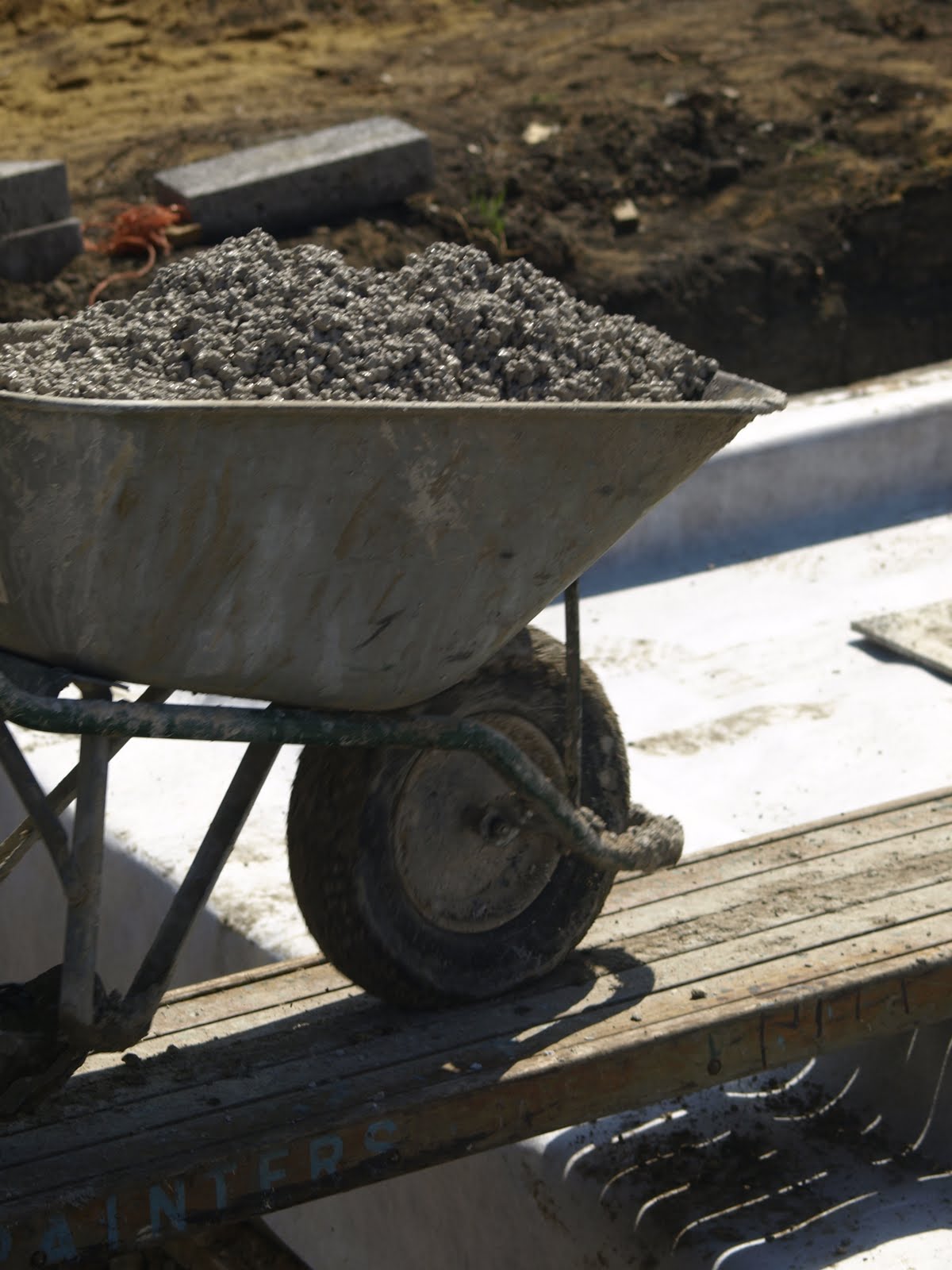
Another barrow almost full.  Small barrows took about 40seconds to fill, larger barrows (like this one) about 1 minute.


After two hours work, another quarter complete (now 3/4 done).


Queuing up ready to fill.  3-4 people on barrows made light work of the tipping.  2 people would have been non stop.


Keying the limecrete batched today to yesterdays half.


The half cast yesterday had hardened on the top enough to lightly walk on it today.  Heavy foot traffic should be avoided however.


Unfortunately the top edge of the rest broke off (it was probably a bit wet still), but there was still a good enough key for the next half.


The dovetail joint in the limecrete after the shutter was removed...

Tuesday, 1 June 2010

Day 51 - Limecrete slab (part 1)


The dovetail shutter in place.  Just need to fill the last little bit in and thats it for today - finished by midday!  Light rain started about 11.30am, so we covered the slab we had already done with more geotextile membrane to protect it.  By the time the main rain set in, we had packed up and were under cover!


The slab will be cast in two halves - today and tomorrow.  The first half will be cast up to this dovetailed stop, which will be placed half way.  This will create a key for the limecrete cast tomorrow.  The timber shutter was wet down before being put in place.  No movement joint is required between the two halves, only around the perimeter.